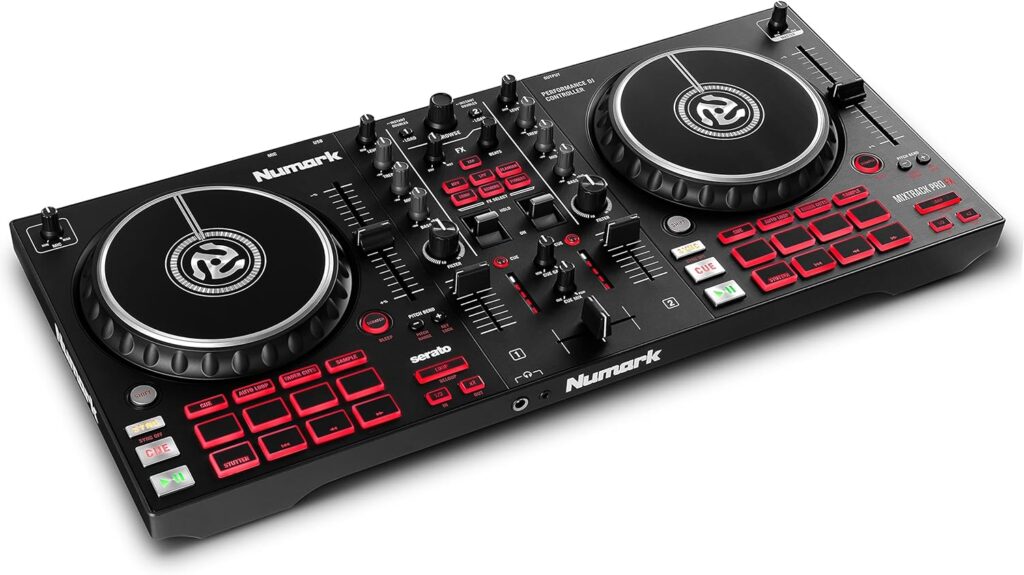
Looking to play your VST synths in a DAW on your laptop or PC, then you will want the best portable MIDI keyboard. This will give you more flexibility as to where you can make your music.
What is Midi?
Firstly what is MIDI? MIDI stands for musical instrument digital interface. It is a way of connecting hardware music synthesisers, sound modules, drum machines and other sound generating equipment. It can also connect to your digital audio workstation. This allows you to play software versions of synths and drum modules and other devices like effects. Midi can be connected via a dedicated 5 pin midi port or via USB or Bluetooth.
There are many midi keyboards on the market with different functionality, size and portability. So it is important to define how and where you will be using it before making your purchase. Of course price is always a determining factor so finding the best cheap midi keyboard will be important.


Size and Portability
For this article we will concentrate on portable midi keyboards for those musicians who make music on the go.
A particular favourite of ours is the AKAI MPK Mini MKII which is a 25 key USB connected and powered keyboard. It has velocity sensitive mini keys that are surprisingly playable. It also has 8 backlit pads for playing drum sounds, for instance in your Ableton drum rack. There are 8 assignable knobs to map to your soft synth to control filter cutoff for example, and a 4 way joystick. You get octave up and down buttons and an arpeggiator with adjustable modes and resolution. Note repeat is another nice touch to quickly create runs of 8th, 16th etc. notes. And when you register your MPK Mini you get some great free sounds. These from the likes of Splice and Loopcloud which is the largest sample library around.
The Arturia Minilab MkII 25 Note controller keyboard is another excellent choice and matches up to the Akai MPK. Also with 25 velocity sensitive keys, it offers 16 rotary encoders to give you huge mapping possibilities. These will allow you to tweak all sorts of parameters to your heart’s content. And the two touch strips give you pitch bend and even more modulation possibilities to get creative with your sound. This is a really great small midi keyboard and it comes with a version of Ableton Lite. Also included is Arturia Analog Lab 2 that gives you sixteen fantastic synths, pianos and organs.


The Arturia Microlab is the option if you really want to go compact. It is extremely compact and with only four buttons and two touch strips, you still have loads of control. A great feature is playing chords with just one note, a bonus for those who don’t have great playing skills. The USB port is recessed so no cables protrude making it easy to transport. And a rubberised case help protect it during travel. Comes with free software and fantastic value for money make it a no brainer.


Use With Ableton Live
Next up is the Novation Launchkey 25 Mk2 Midi Controller keyboard. Again like the others mentioned, it offers 25 synth action keys and excels with 16 velocity sensitive RGB pads. These will get those finger drummers tapping away and there are also 8 knobs for tweaking. Like the others, it comes with great software including Live Lite and Novation’s own excellent V and Bass Station synths.
The Launchpad has been designed specifically to integrate with Ableton Live. Ableton is probably the most popular DAW on the market. Just connect via USB and you get immediate hands on control of your synths, drum racks and session view parameters. Start moving those faders on the mixer and effects dry/wet controls for example. The pads can be used to launch and stop your session view clips. And get this, the RGB colour pads will match the colour of the clips in the software. Nice! This would be a top choice as the best midi keyboard for Ableton.
Another great Novation option.
Sticking with Novation, if you were looking for the best midi portable keyboard for Logic Pro X then the Novation Impulse 61 Keys would have to be a major contender. The Impulse differs in that it is a full size piano style semi-weighted, ultra responsive keyboard with aftertouch that has been designed for those who play keys. It will adapt to playing instruments such as piano, organ or synthesiser. As such this is not a particularly portable midi keyboard controller but that aspect is more than made up with all that it offers. Definitely a choice for the more proficient keyboardists out there.
For Logic users you get mixer, transport and plug in control of Logic’s own plugins as well and VST versions. 9 faders, 8 backlit drum pads, 9 assignable buttons, 8 control knobs and 6 transport buttons give you tremendous control over your DAW , instruments and effects. It does weigh 6.5Kg so will be suited to be your main studio midi controller keyboard. The choice for those who want playability more than anything else, this would be a leading contender as the best weighted midi keyboard.
Less well known brands.
One other option to look at is the Nektar Impact LX25. Not one of the more well known brands, but this one has pretty much everything you need to take control of your synths and fx. A very good option for the best mini midi keyboard, the Nektar offers integration for all the major Daws like Ableton, Logic, Reason, Bitwig, FL Studio, Reaper and others. In fact this model seems to be highly favoured by the Reaper community and once registered comes with a downloadable zip file to get to get you set up and configured straight away. Having a great build quality, you get octave control buttons, “hyper sensitive” led illuminated drum pads that are easily assigned and transport controls which is something we really love. With all these controllers, the software they come with determines how easy it is to set up and play.
Auto selection of parameters
The Nektar allows you to control parameters as soon as you select an instrument track which is assigned automatically. It also has a “grab” mode so you can temporarily assign parameters by simply holding “shift” and clicking and adjusting a parameter on the software, then moving the control on the Nektar. Very useful for quickly tweaking a parameter that was not automatically mapped. This one has to be a choice for the best budget midi keyboard.


How will you use your best portable midi keyboard
All in all the choice for a small midi keyboard depends on your how you want to use it, your space requirements and how important portability is for you. Having so many available that all cover basic requirements for controlling midi on your software or hardware standalone units, you are truly spoilt for choice.
Most portable midi keyboard
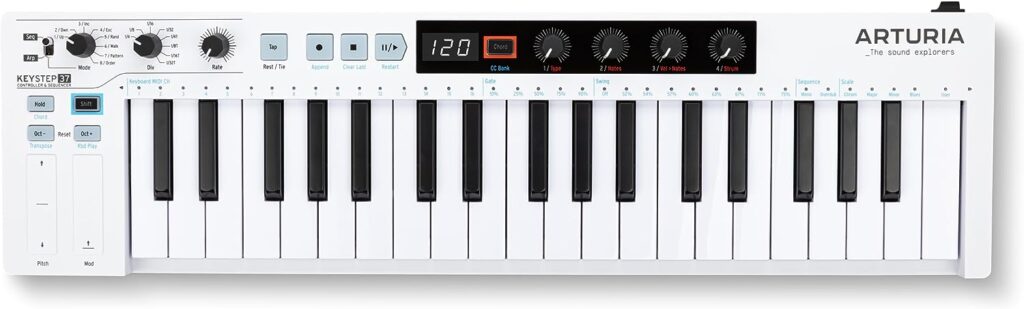
The Arturia Keystep 37 is a MIDI controller and polyphonic sequencer produced by Arturia. It’s an extended version of the original Keystep, offering additional features and a larger keyboard.
The keyboard feels very solid and weighty but without being so much so that you wouldn’t use it as a portable keyboard. Key action is probably the best we’ve used at this price point and size of keyboard.
Here are some key features and details about the Arturia Keystep 37:
- Key Features:
- 37 Slim Keys: The Keystep 37 features a 37-key, slim-key keybed that is velocity-sensitive and aftertouch-enabled.
- Polyphonic Sequencer: It includes a polyphonic step sequencer with up to 64 steps per sequence, allowing for complex and evolving patterns.
- Chord Mode: The Keystep 37 has a Chord mode that enables you to play chord voicings with a single key press.
- Arpeggiator: An arpeggiator is included with multiple modes and settings for creating rhythmic and melodic patterns.
- Touch Strip: The touch strip can be used for pitch bend, modulation, and various other performance controls.
- Connectivity: It offers various connectivity options, including MIDI in/out, USB, CV/Gate outputs, and Sync in/out for integration with other modular or MIDI gear.
- Compact and Portable:
- The Keystep 37 is designed to be compact and portable, making it suitable for musicians on the go or those with limited studio space.
- Integration with Software:
- It can be used as a MIDI controller with software instruments and virtual synths, making it versatile for both hardware and software setups.
- Build Quality:
- Arturia is known for its build quality, and the Keystep 37 is expected to maintain the same level of craftsmanship.
- Software Integration:
- The Keystep 37 integrates well with Arturia’s software instruments and analog synthesizers. It often comes bundled with Analog Lab, providing a wide range of sounds.
- MIDI and CV/Gate Connectivity:
- With both MIDI and CV/Gate outputs, the Keystep 37 is suitable for controlling a variety of synthesizers, including modular setups.
Thoroughly recommend the Keystep 37 as an excellent portable midi keyboard.
Music making has never been easier with the help of midi controllers and finding the best portable midi keyboard will get you up and running in double quick time.